- English
- Chinese
- French
- German
- Portuguese
- Spanish
- Russian
- Japanese
- Korean
- Arabic
- Irish
- Greek
- Turkish
- Italian
- Danish
- Romanian
- Indonesian
- Czech
- Afrikaans
- Swedish
- Polish
- Basque
- Catalan
- Esperanto
- Hindi
- Lao
- Albanian
- Amharic
- Armenian
- Azerbaijani
- Belarusian
- Bengali
- Bosnian
- Bulgarian
- Cebuano
- Chichewa
- Corsican
- Croatian
- Dutch
- Estonian
- Filipino
- Finnish
- Frisian
- Galician
- Georgian
- Gujarati
- Haitian
- Hausa
- Hawaiian
- Hebrew
- Hmong
- Hungarian
- Icelandic
- Igbo
- Javanese
- Kannada
- Kazakh
- Khmer
- Kurdish
- Kyrgyz
- Latin
- Latvian
- Lithuanian
- Luxembou..
- Macedonian
- Malagasy
- Malay
- Malayalam
- Maltese
- Maori
- Marathi
- Mongolian
- Burmese
- Nepali
- Norwegian
- Pashto
- Persian
- Punjabi
- Serbian
- Sesotho
- Sinhala
- Slovak
- Slovenian
- Somali
- Scots Gaelic
- Shona
- Sindhi
- Sundanese
- Swahili
- Tajik
- Tamil
- Telugu
- Thai
- Ukrainian
- Urdu
- Uzbek
- Vietnamese
- Welsh
- Xhosa
- Yiddish
- Yoruba
- Zulu
- Kinyarwanda
- Tatar
- Oriya
- Turkmen
- Uyghur






Best komatsu mini excavator bucket teeth?
2026-02-28
Look, if you’re searching for the best Komatsu mini excavator bucket teeth, you’ve probably already hit the wall of generic advice and glossy catalog specs. Everyone claims durability and performance, but the reality on a muddy jobsite or in rocky trenching is a different beast. The truth is, there’s no single best tooth—it’s about matching the right tooth to the specific job, machine model, and, frankly, your budget and supply chain reality. I’ve seen too many guys order the premium option only to watch it snap on a hidden concrete chunk because the application was all wrong. Let’s cut through the noise.
The Core Misconception: Hardness Isn’t Everything
Most operators and even some parts managers immediately equate best with maximum hardness. They want that rock-solid, seemingly indestructible alloy. But here’s the catch: an extremely hard tooth, like some of the super-high boron steel variants, can become brittle. I ran a set of these on a PC35MR-5 doing utility work. In frost-thaw conditions with mixed debris, we had two teeth shear at the base pin hole within a week. The material didn’t bend or wear; it just gave up catastrophically. The downtime for replacement cost more than the teeth themselves.
What you actually need is a balance: hardness for abrasion resistance on the wearing surfaces, but enough toughness (impact resistance) in the core and at stress points to handle sudden shocks. For mini excavators, which often do precise, sometimes erratic digging versus constant loading like a big machine, this toughness is critical. A good supplier will talk to you about the heat treatment process—through-hardening vs. selective hardening—not just throw a Rockwell C number at you.
This is where the OEM spec from Komatsu is a good baseline, but not the final word. Their teeth are engineered for a broad average of conditions. If your work is consistently in one material type—say, sandy clay or pure loose topsoil—you can deviate from that spec for better cost-efficiency or longevity. But you need to know what you’re deviating from first.
Profile & Geometry: The Unsung Heroes
Teeth aren’t just blunt spikes. The profile—whether it’s a long, sharp penetration point, a rounded digging edge, or a multi-angle design—dictates how the bucket enters and breaks material. For a mini ex, you’re often working in tight spaces, maybe next to foundations or pipes. A tooth with too aggressive a penetration angle can make the machine lurch and be harder to control smoothly.
I prefer a medium-length, slightly rounded point for general use on machines like the PC30 or PC50. It provides a good balance of digging force and control. We once tried a set of ultra-sharp, long-taper teeth on a PC78 for a drainage project. In the soft ground, they were fantastic, sinking in effortlessly. But when we hit a patch of old, compacted gravel, the tips deformed and rolled over because the fine point couldn’t distribute the load. Had to switch back mid-job.
The locking system geometry is another practical headache. The Komatsu-style pin-and-retainer system is generally robust, but aftermarket teeth sometimes have tolerances that are a hair off. This leads to either a frustratingly tight fit that needs a sledgehammer to install or, worse, a loose fit that causes the tooth to wiggle and accelerate wear on the adapter. That clunking sound you hear on the swing? Could be a loose tooth, and it’s chewing up your hardware.
The Adapter is Part of the Equation
You can’t talk about teeth without looking at what they mount to. The adapter nose takes a brutal beating. If you’re constantly changing teeth, check the adapter wear. A worn adapter will never hold a new tooth properly, no matter how good the tooth is. It creates a pivot point that increases stress.
I made this mistake early on. We kept buying mid-grade replacement teeth for an older PC45, complaining they were wearing out too fast. Finally, a seasoned mechanic pointed out the adapters were so worn they had a visible backward tilt. The tooth was hitting the ground at a bad angle, concentrating all the force on one side. Replaced the adapters (a more expensive fix, admittedly) and the next set of teeth lasted three times longer. Now it’s a standard check on our PM list.
Some aftermarket kits offer teeth and adapters as a matched set. This isn’t a marketing gimmick. It ensures the mating surfaces and lock mechanism are designed to work together. If you’re not using OEM teeth, considering a matched set from a reputable manufacturer can save a lot of hidden hassle.
Supply Chain & The Real World Availability
This is the part the brochures ignore. The theoretical best tooth is useless if you can’t get it for three weeks when you’re in the middle of a job. Relying solely on the official Komatsu parts network is ideal but can be prohibitively expensive or slow in some regions, leading to massive machine downtime.
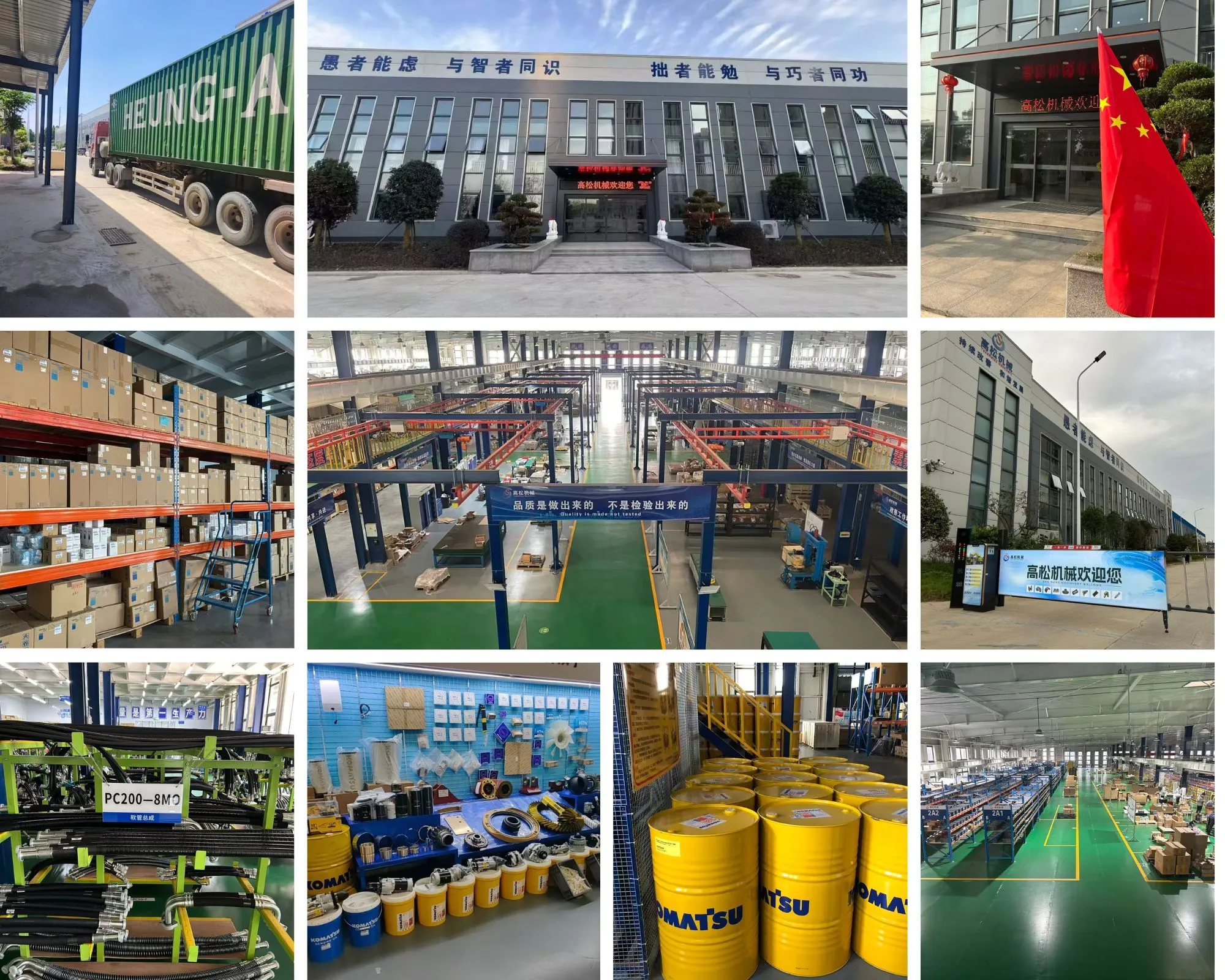
This is where third-party suppliers who understand the Komatsu system become invaluable. They fill a crucial gap. For instance, a company like Jining Gaosong Construction Machinery Co., Ltd. operates in this space. As they note on their site https://www.takematsumachinery.com, they are an OEM product supplier within the Komatsu system and also act as a third-party sales channel. In practice, what this means for someone like me is access to parts that meet or closely mirror OEM specifications, often with better availability or pricing in certain markets, helping to solve those real-world supply challenges. They’re not just a random aftermarket shop; they’re integrated into the ecosystem. When you’re sourcing, looking for a supplier with that specific kind of dual-role credibility is a smart move. It bridges the gap between pure OEM and generic aftermarket.
I’ve worked in countries where official parts distribution was thin. Having a reliable contact who could provide compatible, quality-assured teeth that fit a Komatsu PC60 without modification was a project saver. You develop a shortlist of these go-to suppliers for critical wear parts.
Material & Application Matching: A Quick Guide
So, pulling this all together, here’s my rule-of-thumb, born from trial and error. It’s not exhaustive, but it’s a start.
For mini excavator work in loose to medium soils (landscaping, backfilling): A standard carbon steel tooth with good toughness is fine. Don’t overpay for ultra-premium alloys. Focus on a secure lock and a profile that gives you control. Chisel or rounded points work well.
For mixed debris and demolition (concrete breakup, asphalt, root-infested soil): You need impact resistance. Look for a medium-alloy steel tooth, maybe with a reinforced base or a thicker web design. A twin-peak or pyramid-style tooth can sometimes handle the variable impacts better than a single long point.
For abrasive materials (sandy soil, gravelly clay): This is where hardness and wear resistance matter. A higher boron steel or a tooth with a welded wear cap on the top surface can extend life significantly. The trade-off is potential brittleness in very cold conditions or with major impacts.
The final, non-negotiable point: buy at least one full spare set for the machine. When a tooth breaks, you usually need to replace the opposing one on the bucket to maintain balance. Having them on the truck means you lose an hour, not a day.