- English
- Chinese
- French
- German
- Portuguese
- Spanish
- Russian
- Japanese
- Korean
- Arabic
- Irish
- Greek
- Turkish
- Italian
- Danish
- Romanian
- Indonesian
- Czech
- Afrikaans
- Swedish
- Polish
- Basque
- Catalan
- Esperanto
- Hindi
- Lao
- Albanian
- Amharic
- Armenian
- Azerbaijani
- Belarusian
- Bengali
- Bosnian
- Bulgarian
- Cebuano
- Chichewa
- Corsican
- Croatian
- Dutch
- Estonian
- Filipino
- Finnish
- Frisian
- Galician
- Georgian
- Gujarati
- Hausa
- Hawaiian
- Hebrew
- Hmong
- Hungarian
- Icelandic
- Igbo
- Javanese
- Kannada
- Kazakh
- Khmer
- Kurdish
- Kyrgyz
- Latin
- Latvian
- Lithuanian
- Luxembou..
- Macedonian
- Malagasy
- Malay
- Malayalam
- Maltese
- Maori
- Marathi
- Mongolian
- Burmese
- Nepali
- Norwegian
- Pashto
- Persian
- Punjabi
- Serbian
- Sesotho
- Sinhala
- Slovak
- Slovenian
- Somali
- Samoan
- Scots Gaelic
- Shona
- Sindhi
- Sundanese
- Swahili
- Tajik
- Tamil
- Telugu
- Thai
- Ukrainian
- Urdu
- Uzbek
- Vietnamese
- Welsh
- Xhosa
- Yiddish
- Yoruba
- Zulu
- Kinyarwanda
- Tatar
- Oriya
- Turkmen
- Uyghur






Kmax teeth: innovation or maintenance focus?
2026-02-14
You hear Kmax thrown around a lot these days, usually paired with innovation or next-gen. But after sourcing and testing these teeth for various projects, I’ve started to question that framing. Is the real story about a groundbreaking design, or is it more about shifting the entire maintenance paradigm? Most discussions miss the practical, gritty middle ground where these parts actually live.
The Spec Sheet vs. The Field Reality
On paper, Kmax teeth, particularly for Komatsu excavators, promise a lot. The metallurgy specs are impressive, and the design aims for better penetration and retention. But the first time we got a batch in, the conversation wasn’t about lab reports. It was about whether they’d last a full shift in the mixed, abrasive material at a site we were supporting. The initial fit was good, but that’s just day one. The innovation claim feels premature until you’ve seen a product cycle through.
I recall a project where we were using OEM-spec parts. The performance was solid, predictable. Then we trialed a set of Kmax-style teeth from a supplier, not Komatsu themselves, but one operating within that ecosystem. The wear pattern was different—not worse, just different. It started wearing more evenly across the top rather than deforming at the tip first. That made me think: maybe the innovation isn’t a single feature, but a different wear characteristic that changes how you plan maintenance intervals.
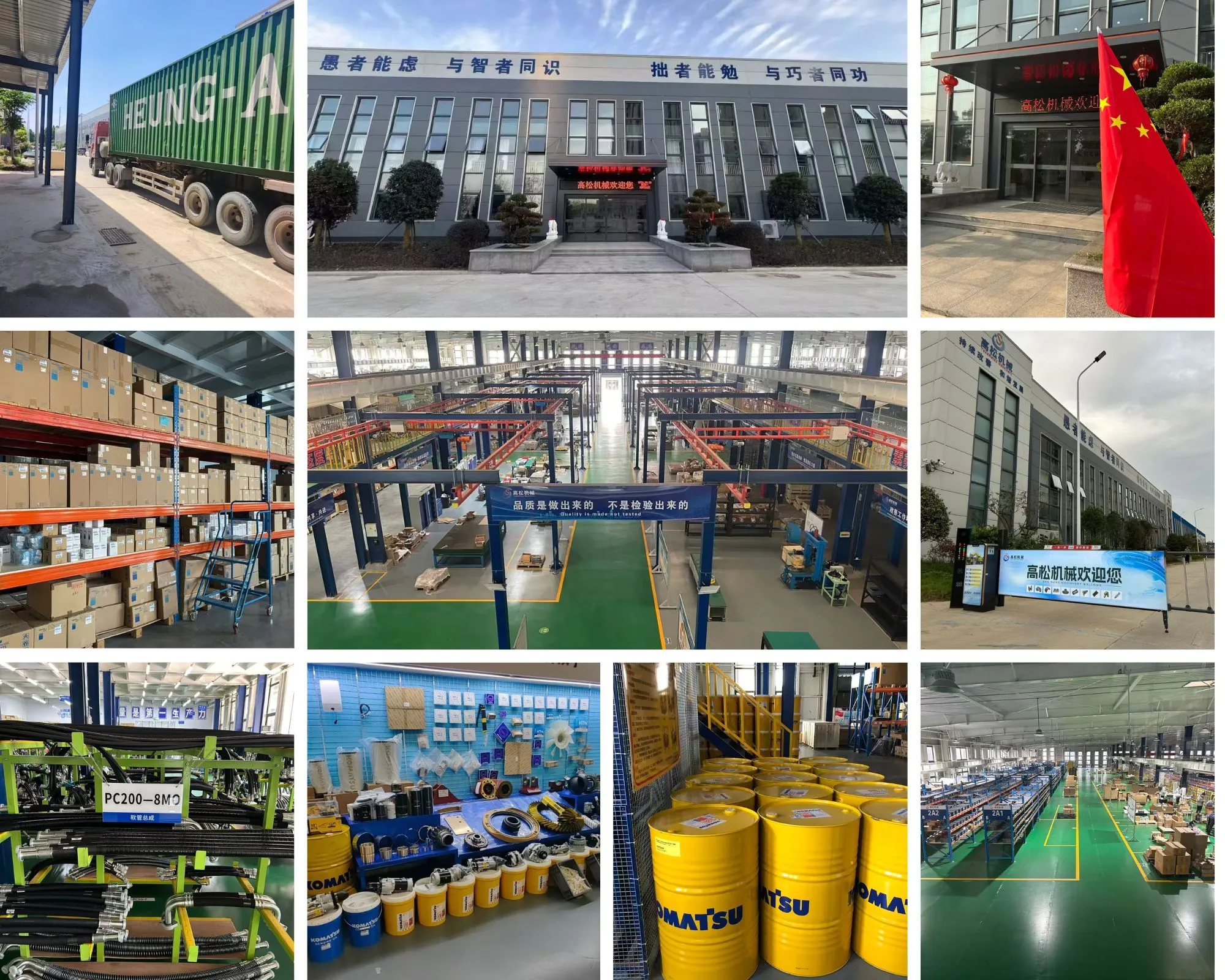
This is where companies like Jining Gaosong Construction Machinery Co., Ltd. come into the picture. They position themselves as an OEM product supplier within the Komatsu system and a third-party sales company. In practice, this means they often handle the parts that fill supply gaps. When you’re dealing with a delayed shipment of genuine Kmax teeth for a Komatsu PC300, a reliable third-party supplier isn’t just a vendor; they’re what keeps the machine from sitting idle. Their site, https://www.takematsumachinery.com, often lists availability for these hard-to-find wear parts. Their role underscores a key point: the innovation in the part itself is only as good as the system that gets it to the machine on time.
Maintenance as the True Driver
Here’s the core of it: if a tooth is 20% more wear-resistant but requires a special, unavailable press to change, it’s a net loss. The focus on Kmax, in my experience, has gradually shifted from ultimate performance to predictable maintenance. The design often incorporates features like wider wings or different locking mechanisms that aim to reduce the chance of accidental loss. That’s not sexy innovation; that’s practical risk mitigation.
We tried a set on a fleet of mid-sized excavators. The goal wasn’t to set a production record. It was to see if we could standardize the change-out interval across the fleet to align with our 250-hour service schedule. With the previous mix of teeth, change-outs were all over the place. The Kmax teeth, surprisingly, brought that into line. Their wear was more linear. That’s a huge operational win—it turns maintenance from a reactive firefight into a planned activity. That’s where the real value gets created, far from the marketing brochures.
I’ve also seen the opposite. A contractor insisted on using a compatible Kmax tooth that was slightly off-spec to save cost upfront. The result was accelerated wear on the adapter nose. The total cost, including the adapter, dwarfed the initial savings. This is the critical judgment call: viewing the tooth not as a standalone item, but as a key component in a wear system. The innovation is pointless if it damages the more expensive base machine part.
The Supply Chain Is Part of the Design
You can’t talk about these parts without talking about logistics. An innovative part stuck in a port for weeks is worthless. The challenges in certain countries that Jining Gaosong mentions in their intro—helping to solve parts supply challenges—are real. I’ve been in situations where the choice of tooth brand/model was dictated 40% by performance and 60% by what was available locally or could be air-freighted without massive delays.
This reality forces a different kind of focus. It makes you evaluate Kmax or any similar system not just on its metallurgy, but on its supply chain resilience. Does the design use common, replaceable lock pins? Are the dimensions standard enough that a competitor’s tooth could be a temporary fix in a pinch? Sometimes, the most innovative design is the one that acknowledges the chaotic reality of a mining site or a remote civil engineering project.
We learned this the hard way. Committed to a specific, high-performance Kmax variant for a full year, only to have the supplier’s quality consistency drop. The teeth in batch three were not the same as batch one. Suddenly, our planned maintenance intervals were useless. We had to scramble and source from an alternative like the third-party channels Gaosong operates in. It was a stark lesson: the part’s design is inseparable from the reliability of its source.
Cost Analysis Beyond the Price Tag
The financial discussion is never just about dollars per tooth. It’s about total cost per operating hour. A cheaper tooth that wears fast increases machine downtime for changes. A more expensive tooth that lasts longer but is a nightmare to remove can increase labor costs. The Kmax proposition often sits in the middle: a moderate premium for a part designed for easier, more predictable replacement.
I did a rough calculation for a client comparing three options: genuine Komatsu, a premium third-party Kmax-style, and a budget generic. The genuine part was, unsurprisingly, the most expensive upfront. The budget part was cheapest. But the Kmax-style option from a reputable third-party supplier had the lowest total cost over 2000 hours when you factored in two fewer change-outs and reduced risk of adapter damage. That’s the maintenance focus paying off directly on the balance sheet.
This analysis fails, however, if the part quality isn’t consistent. This is the gamble. You’re betting that the engineering and QC behind the Kmax design, even from a third-party, is robust. When it pays off, it feels less like a technological revolution and more like a very sound, boringly effective procurement decision.
The Verdict from the Trenches
So, innovation or maintenance focus? After all this, I lean heavily toward it being a maintenance-focused innovation. The true advancement of systems like Kmax isn’t necessarily a new alloy (though that helps). It’s the integration of design thinking that prioritizes predictable life cycle, easier serviceability, and compatibility within a volatile supply chain.
The companies that thrive in this space, whether OEMs or trusted third-party entities, are those that understand this duality. They sell a part, but they’re really selling reliability and predictability. When you look at a supplier’s portfolio, like the one you’d find at takematsumachinery.com, you’re not just looking at a product list. You’re looking at a set of solutions for keeping machines running under real-world constraints.
In the end, the best wear part is the one you don’t have to think about too much. It goes on, it works for a predictable period, it comes off without a fight, and you can get another one without re-engineering your entire logistics plan. If that’s the benchmark, then the focus on Kmax is rightly on maintenance. The innovation is simply what makes that focus possible. It’s a tool for better operations, not a trophy for the engineering department. And in this business, that’s what actually matters.