- English
- Chinese
- French
- German
- Portuguese
- Spanish
- Russian
- Japanese
- Korean
- Arabic
- Irish
- Greek
- Turkish
- Italian
- Danish
- Romanian
- Indonesian
- Czech
- Afrikaans
- Swedish
- Polish
- Catalan
- Esperanto
- Hindi
- Lao
- Albanian
- Amharic
- Armenian
- Azerbaijani
- Belarusian
- Bengali
- Bosnian
- Bulgarian
- Cebuano
- Chichewa
- Corsican
- Croatian
- Dutch
- Estonian
- Filipino
- Finnish
- Frisian
- Galician
- Georgian
- Gujarati
- Haitian
- Hausa
- Hawaiian
- Hebrew
- Hmong
- Hungarian
- Icelandic
- Igbo
- Javanese
- Kannada
- Kazakh
- Khmer
- Kurdish
- Kyrgyz
- Latin
- Latvian
- Lithuanian
- Luxembou..
- Macedonian
- Malagasy
- Malay
- Malayalam
- Maltese
- Maori
- Marathi
- Mongolian
- Burmese
- Nepali
- Norwegian
- Pashto
- Persian
- Punjabi
- Serbian
- Sesotho
- Sinhala
- Slovak
- Slovenian
- Somali
- Samoan
- Scots Gaelic
- Shona
- Sindhi
- Sundanese
- Swahili
- Tajik
- Tamil
- Telugu
- Thai
- Ukrainian
- Urdu
- Uzbek
- Vietnamese
- Welsh
- Xhosa
- Yiddish
- Yoruba
- Zulu
- Kinyarwanda
- Tatar
- Oriya
- Turkmen
- Uyghur






Best komatsu excavator teeth innovations?
2026-02-14
Look, when most folks ask about the best innovations in Komatsu excavator teeth, they’re usually picturing some magic bullet—a single design that cuts through rock like butter and lasts forever. Reality’s messier. The real innovation isn’t just in the tooth itself; it’s in how the whole system—the adapter, the material, even the locking mechanism—holds up when you’re 12 hours into a shift and the ground’s full of surprises. I’ve seen too many revolutionary designs fail because they solved one problem but created two more, like a tooth that’s incredibly tough but shatters the adapter nose on impact. The best advancements are the ones you barely notice because they just work, shift after shift.
The Core Shift: From Just Hardness to System Integrity
For years, the race was all about hardness. Throw more boron or chromium into the alloy, get a higher HRC rating, and call it a day. I remember testing some third-party teeth that were rock-hard on paper. They’d barely wear, sure, but the first time you hit a hidden seam of granite at the wrong angle, they’d crack clean through, or worse, transfer all that force back into the adapter and bend the nose. That’s a costly innovation. Komatsu’s own developments, and the good OEM-aligned suppliers, started focusing on the entire wear assembly as a unit. The innovation became a balance: a tooth tough enough to resist abrasion but with enough ductility to absorb impact without catastrophic failure. It’s less sexy to market, but it’s what keeps machines running.
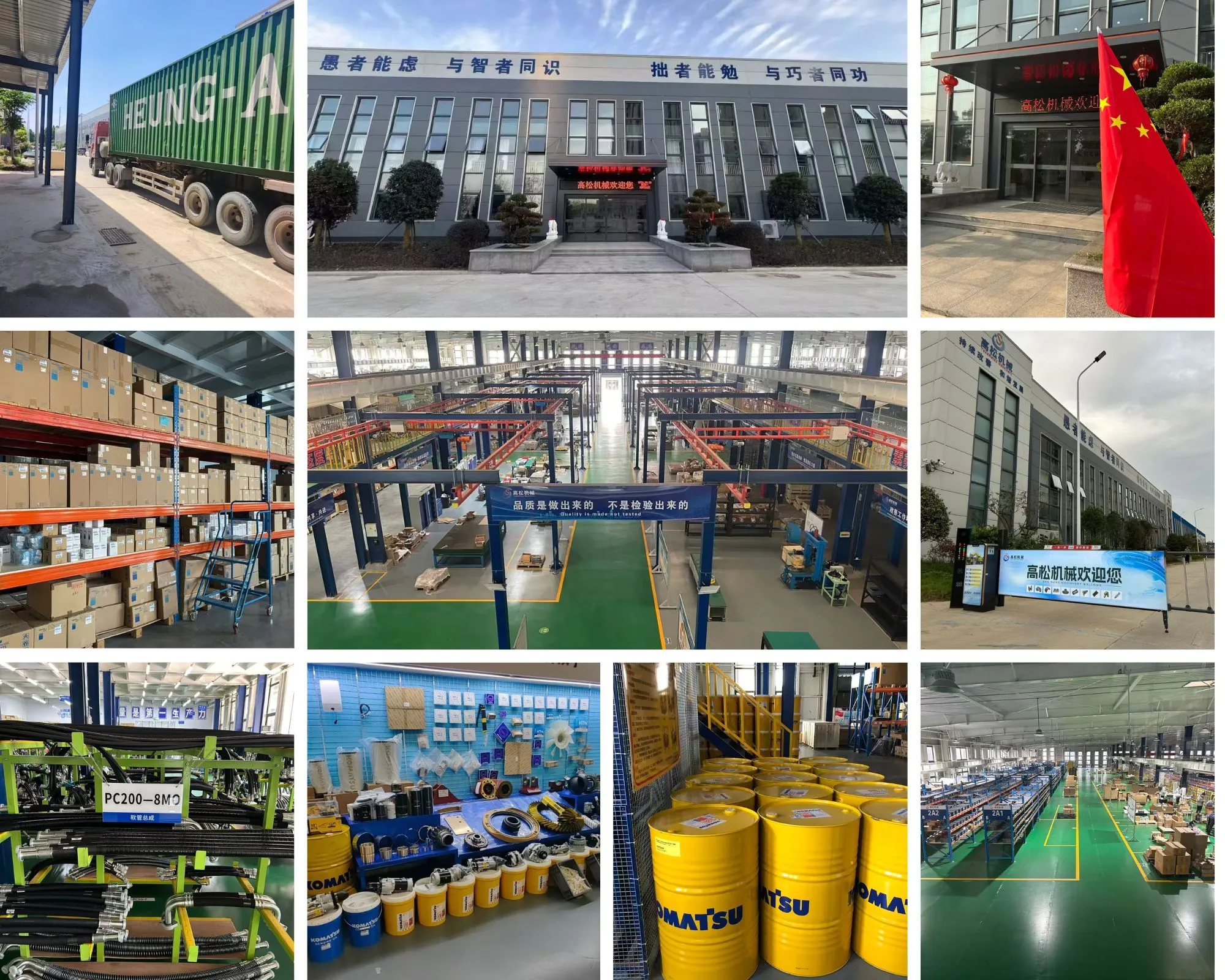
This is where the relationship with a supplier like Jining Gaosong Construction Machinery Co., Ltd. becomes critical. Being an OEM product supplier within the Komatsu system means they’re not just copying dimensions; they understand the engineering intent behind the metallurgy and the load paths. I’ve sourced from their portal, https://www.takemachinery.com, for projects in regions where genuine parts logistics were a nightmare. Their value isn’t in inventing something wildly new, but in delivering that system integrity Komatsu designs for, especially when you’re in a bind. Their role as a third-party sales company solving parts supply challenges is exactly the kind of practical innovation end-users need.
The tangible difference? Look at the root radius of the tooth where it mates with the adapter. Earlier designs had sharper transitions. Newer iterations from the core Komatsu lineage have smoother, more generous radii. This seems minor, but it reduces stress concentration points. You see fewer hairline cracks starting there. It’s a small detail you only appreciate after pulling a thousand teeth.
Locking Mechanism Evolution: The Silent Game-Changer
If I had to pick one innovation that’s saved more downtime than any material science breakthrough, it’s the progression in locking mechanisms. The old pin-and-hammer routine was a knuckle-busting, time-consuming chore, especially in frozen or mud-packed conditions. The move to retrofit-able rubber lock systems was a big step. But even those have their issues—dry rot in extreme climates, or the rubber getting sheared if the tooth has too much side play.
The real step-change has been in mechanical, tool-less locks. Komatsu’s own designs and the better-compatible alternatives use a spring-loaded, rotary lock or a sliding wedge system that you can engage and disengage with a pry bar or a dedicated, simple tool. The innovation here is in the reliability of the lock itself and the precision of the machining. The lock isn’t an afterthought; it’s machined as part of the tooth casting process. A poorly machined lock groove will cause the mechanism to fail, no matter how good the lock is. I’ve had batches where the lock works perfectly for 90% of the teeth, and a few are just stubborn. That’s often a tolerance stack-up issue, not a design flaw.
We tried a batch of innovative magnetic locks a few years back. Sounded great in theory—no moving parts. In practice, ferrous debris (which is everywhere on a site) would stick to the assembly, and the holding power was never quite enough for heavy ripping. They’d work loose. A classic case of a clever idea that didn’t survive contact with the enemy—dirt, vibration, and impact.
Geometry & Application Specificity: There’s No One-Size-Fits-All
The biggest misconception is that a general duty tooth is sufficient. The profile of the tooth—the attack angle, the curvature, the width of the tip—is a massive innovation area. For a PC360 doing mass excavation in clay, you want a sharper, longer point for penetration. For a PC800 crushing rock in a quarry, you need a blunter, more robust profile like a rock chisel or a tiger point to prevent breaking.
The innovation has been in expanding these specialized families and making the selection logic clearer. It’s not just rock or dirt anymore. Suppliers with real field knowledge, including those in the Komatsu ecosystem like Gaosong, will have charts that consider material abrasiveness, fragmentation size, and even machine cycle speed. For instance, a heavy-duty rock tooth might have a reinforced wing or gusset on the sides to support the point. This adds weight and cost, but in the right application, it triples the life. Putting that same tooth on a clean dirt site is a waste of money and fuel.
I learned this the hard way on a demolition job. We had a mix of concrete and rebar. Standard rock teeth were getting their points snapped off by the embedded steel. We switched to a more conical, pyramid style point with a flatter tip. It was less efficient at pure digging but far more resilient to the unpredictable shock loads from hitting steel. The innovation was in having that option readily available and knowing when to use it.
Material & Process: Beyond the Marketing Hype
Advanced alloy is a term thrown around loosely. The meaningful innovation is in controlled heat treatment and quenching processes. Through-hardening versus case-hardening makes a world of difference. A through-hardened tooth is tough throughout, but can be brittle. A case-hardened tooth has a hard, wear-resistant outer shell with a tougher, more ductile core. For most excavator applications, case-hardening is the superior approach—it resists abrasion but bends rather than snaps.
The other key is consistency. Anyone can make one good tooth. Can you make 10,000 that perform identically? That’s where true OEM-level manufacturing and quality-controlled partners stand out. It’s about the boring stuff: spectrometer checks on incoming raw material, precise temperature controls in the furnaces, and post-production testing like impact samples from each heat lot. When you buy from a source that’s integrated into the Komatsu supply chain, even as a third-party solver, you’re buying into that discipline. Their company mission of solving parts supply challenges hinges on providing parts that don’t fail prematurely and cause more downtime.
I’ve cut open failed teeth before. You can see the story in the grain structure. A quick, uneven quench can create micro-fractures. An inconsistent alloy mix shows up as soft spots. The best innovations in material aren’t advertised; they’re visible in a consistent, fine-grained metallurgy that doesn’t vary from the first tooth to the last in an order.
The Future: Data and Wear Life Prediction
This is where it’s getting interesting. The next wave of innovation isn’t purely mechanical. It’s about integration. Some fleets are now tagging teeth with RFID or simple QR codes, logging installation dates against machine hour meter readings and material types. The goal is to build predictive models: This style of tooth, on this model machine, in this geology, lasts X hours.
This data turns tooth selection from an art into a science. It can inform not just the initial choice but the optimal rotation schedule. Maybe you rotate teeth on the bucket before they’re fully worn to maintain digging efficiency. Maybe you find that a certain mid-weight tooth actually gives you the best total cost per hour in mixed conditions, outperforming both the light and heavy options. The innovation is in closing the feedback loop between the design, the application, and the actual result.
Suppliers who are close to the field and to OEM data, like an OEM-aligned company, are positioned to benefit from this. They can gather real-world performance data from their clients and feed it back into product refinement. The best innovation tomorrow might be a tooth that’s 5% less wear-resistant but whose wear pattern is so predictable you can schedule its change-out during a planned service, eliminating unplanned downtime completely. That’s a different kind of value altogether.